
They Needed a Blister for a Syringe. So We Asked Them to Post Us a Hundred of Them.
A medical device maker in North Carolina needed to blister-pack a part that was not a tablet and not a capsule. From the first inquiry to a finished forming layout took one week — because we designed the pocket around a hundred real syringes rather than a drawing. Then we told them to stop using the film they had planned on.
Medical device maker
North Carolina, USA
Pre-filled syringes,
irregular shape
DPP-150E blister line
10-40 punches/min
Tyvek and PETG,
four up
Most blister projects start with a product that is a disc. This one did not, and almost everything that followed came out of that single fact.
The part was not a tablet
The inquiry arrived at the end of April 2023, from North Carolina. It asked about a blister machine, which is an ordinary enough request. Then we asked what they were packing, and the answer was not ordinary at all.
Not tablets. Not capsules. Syringes — long, round, with a barrel, a flange and a plunger, and nothing about them that sits flat in a pocket designed for a pill.
Most of what a blister machine does all day is tablets and capsules. A tablet is a disc. You can look at a drawing of a disc and know what the pocket needs to be. A syringe is none of those things: it has a taper, it rolls, it has a flange that has to be supported or the whole part tips in the pocket, and it is long enough that four of them across a web is already a 145 mm film.
So the first thing we did was not quote. It was show them what we had packed before. We had done irregular device parts in blisters for years, and we had the projects to point at. That was the conversation that got us to the second one.
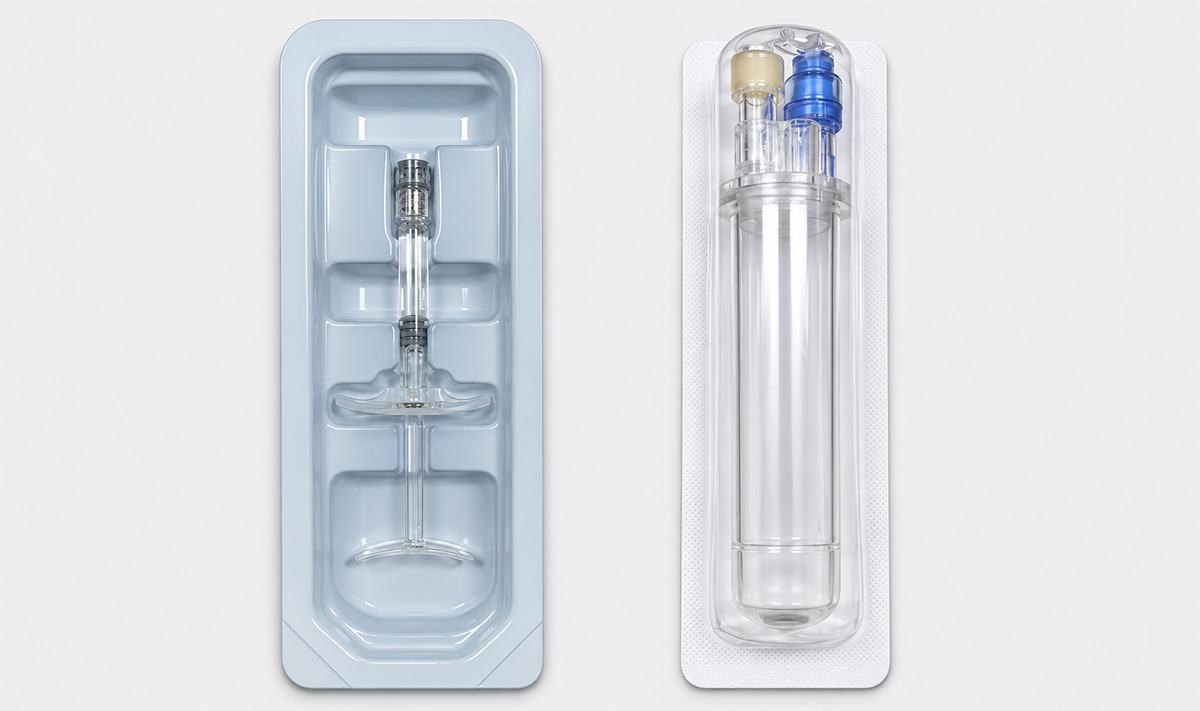
The customer’s part: not a tablet, not a capsule — a syringe with a barrel, a flange and a plunger, none of which sit flat.
A hundred real parts, not a drawing
Here is the part that decided the project: we asked them to post us a hundred syringes.
A drawing gives you dimensions. The real part gives you behavior — how it sits, where it wants to roll, what the flange does when the forming tool pulls the film down around it, whether the pocket holds it or lets it shift on the way to the sealing station. For an irregular part, designing from a drawing is guessing with extra steps. And we needed the real part anyway: you cannot run a proper acceptance test before shipment without the customer’s own product in the machine.
Samples moved faster than anyone expected. We arranged the collection from their plant ourselves rather than leaving it to them to arrange, and the box was in our hands four days after it left North Carolina.
That compressed the whole front end of the project. Inquiry, material confirmed, samples collected, forming layout drawn — the entire sequence took one week.
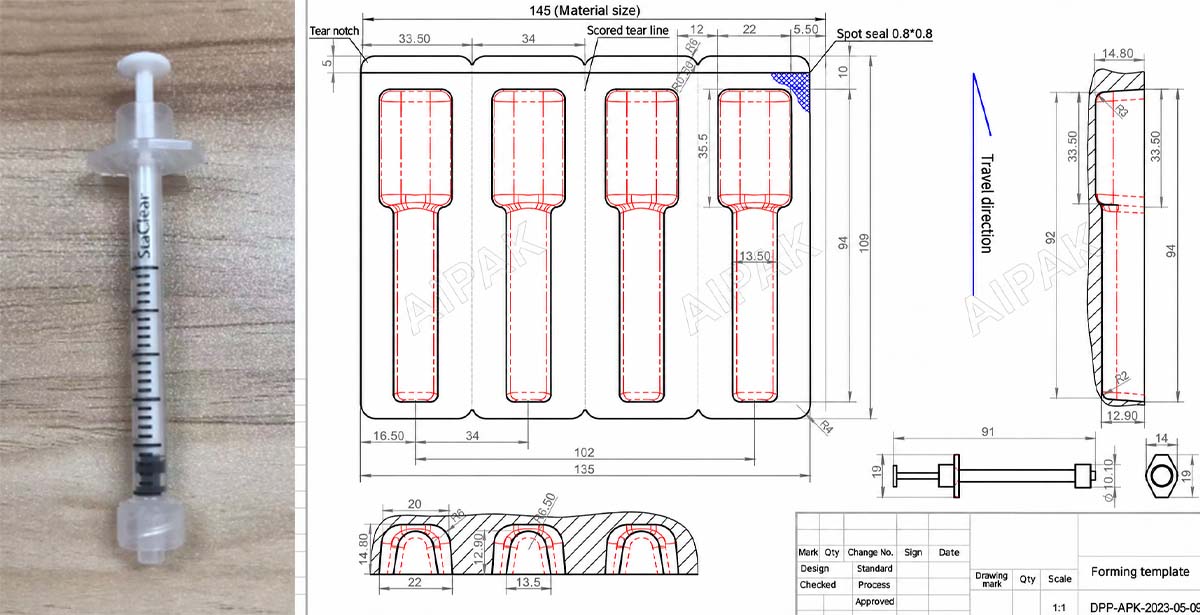
The layout we sent back: four pockets across, each one shaped to the part we had in our hands.
Why we talked them out of foil
A blister machine usually runs PVC and aluminum foil, or alu-alu. Those materials are good at what they are asked to do: they seal well and they keep moisture out, which is what a tablet needs.
This part did not need moisture protection first. It needed a bacterial barrier, and it needed to survive being sterilized after it was packed — because the pack would be opened in a clinical setting, not a kitchen.
So we recommended against the standard materials and proposed Tyvek with PETG instead. Tyvek blocks bacteria while still peeling open cleanly in one piece, which matters when someone is opening it wearing gloves. PETG takes the heat, so the customer could sterilize the finished pack themselves afterwards.
Then we posted them samples at several thicknesses, each one labeled in red, so they could hold the material and decide rather than approve a specification on paper.
This is the part of the project we would want a reader to notice. Nobody asked us to re-specify the film. The customer came to us for a machine. But the machine is only as good as what you run through it, and recommending the obvious material would have produced a pack that sealed beautifully and failed at the only job it had.
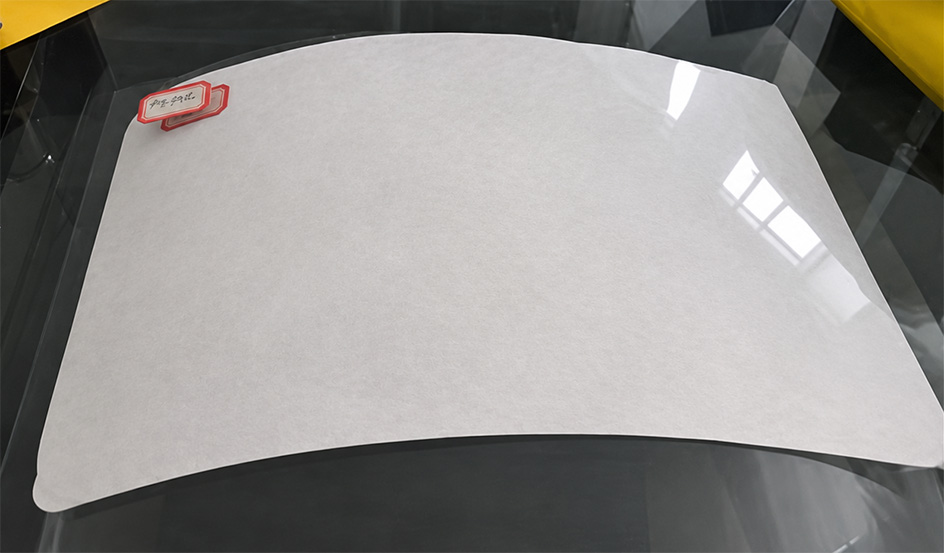
Thickness samples, labeled in red, posted out so they could handle the material before committing to it.
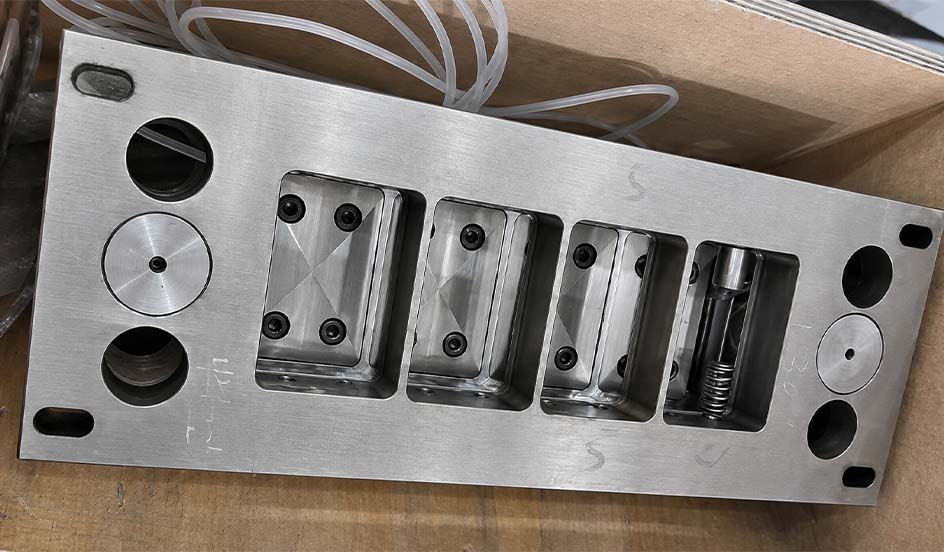
The tool cut from that layout.
The code had to scan, not just print
With the machine, the layout and the film agreed, the customer sent their artwork. It carried a batch code and a variable QR code — every pack coded individually, which is standard for this kind of product.
We sized two coders to that artwork. Then we went and tested them, because Tyvek worried us.
Tyvek is not paper, whatever it looks like. It has a non-woven structure, and ink behaves differently on it than on a smooth film — characters can blur, and a blurred QR code is not a cosmetic problem. It is a pack that cannot be read at the other end.
So we adjusted the coders and ran them again, and adjusted them again, until the codes came out scannable off the actual material. Then we filmed somebody scanning one, and sent the video over before shipment, so the customer did not have to take our word for it.
Three spare blades, and a film spec they had not asked for
Two small things went into the crate that nobody requested.
The first was three extra cutting blades. PETG is harder than PVC, and a harder film wears a blade faster. We would rather send the spares with the machine than have the line stop six months later while a blade crosses the Pacific.
The second was not a part at all. Before they ordered their first proper run of film, we told them the maximum roll diameter, the maximum core size and the maximum roll weight the machine accepts — so that when they bought material in volume, it fit the machine they had just bought.
Neither of these is clever engineering. Both of them are the difference between a machine that works on the test floor and a line that keeps running.
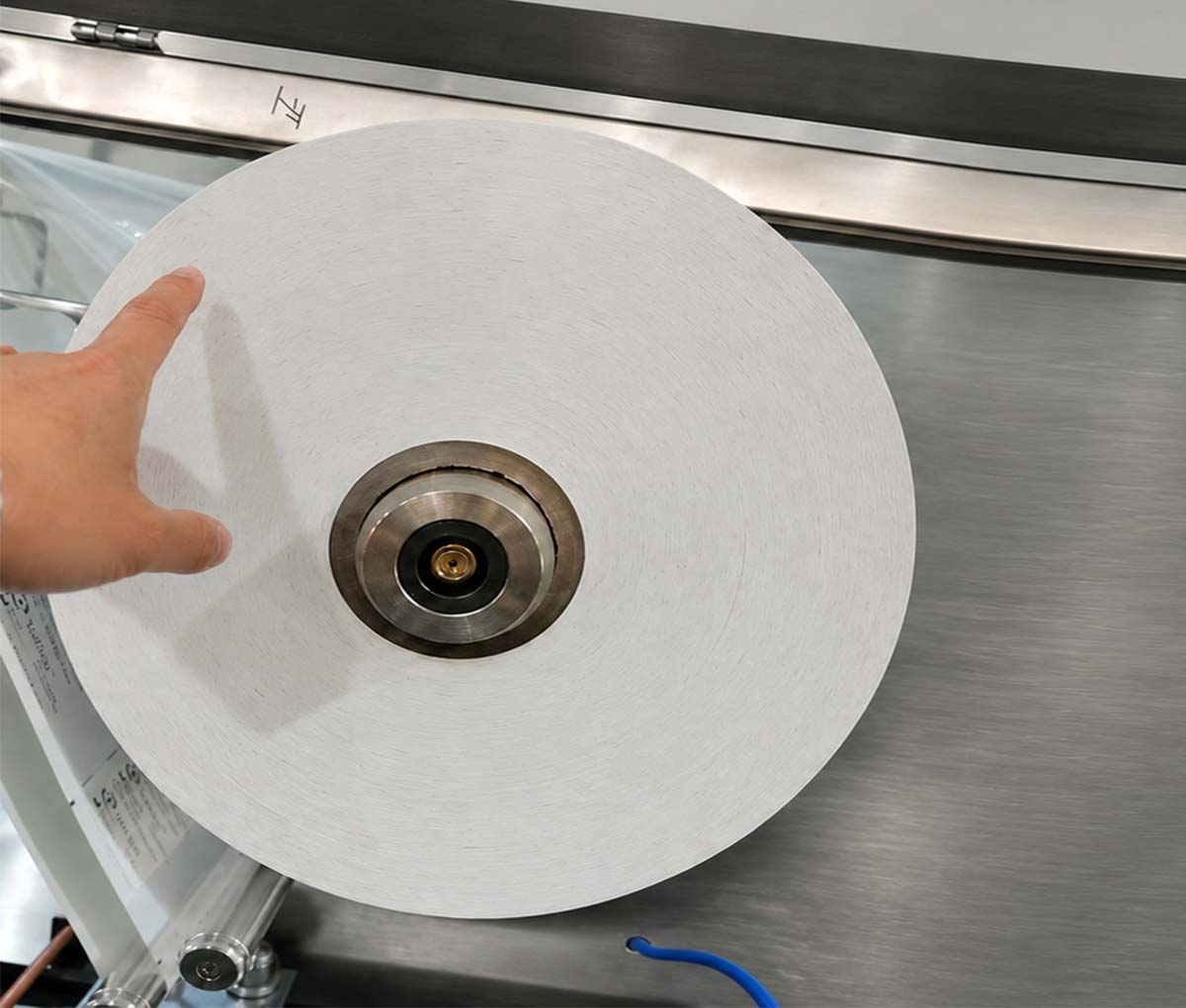
The roll on the machine. Core diameter and roll weight are not details you want to discover after the first delivery arrives.
A wire for a robot we did not build
Syringes are a high-volume disposable. Somebody was going to be standing at that machine loading pockets by hand, shift after shift, and we said so: this is a job for a robot.
The customer agreed with the idea and disagreed with the supplier. They wanted to buy the robot from a company in the United States, close enough to support it, rather than have it shipped from China with the machine. That is a reasonable thing to want, and we did not argue.
What we did instead was leave them a signal interface on the blister machine, wired and documented, before it shipped. The machine could tell a robot when to load and when a cycle was finished — to a robot that did not exist yet, from a company we had never worked with.
Months later their integrator connected to it. When questions came up about how the two machines should talk to each other, we worked through it with their engineer over video. The robot runs.
The interface cost us almost nothing to include at build time. Adding it afterwards, to a machine already installed in North Carolina, would have been a different conversation entirely.
The robot the customer bought locally, loading the machine through a signal we left for it.
Then we got on a plane
Our CEO travels to see customers every year. Not long after this line was running, North Carolina was on the route.
Before the trip we asked the customer a practical question: do you need any parts, and is anything on the machine not behaving? If so we would bring the parts in the luggage and deal with it during the visit. The answer was that the machine was running fine.
So the visit was not a service call. It was a conversation about packaging and about what was happening in their market, between two people who had until then only met over email and video.
One thing he said has stayed with us since.
North Carolina, after the line had been running a few months
We are a Chinese supplier, eleven thousand kilometers away, and we were the first one to turn up. That is worth knowing if you are deciding whether distance is a reason not to work with us.
If your part is not a tablet, most of this case study is the answer to the question you are about to ask us. Send us the part. We will tell you what the pocket has to do, what the film has to survive, and what will go wrong in month six — before you order anything.
What this line was built from
| Blister machine | DPP-150E, four up for this pocket size. |
| Forming film | PETG, selected for heat resistance so the finished pack could be sterilized later. |
| Lidding material | Tyvek, selected as a bacterial barrier that still peels cleanly. |
| Coding | Two coders, sized to the customer’s batch code and variable QR artwork. |
| Spares in the crate | Three extra cutting blades, because PETG wears a blade faster than PVC. |
| Reserved | A signal interface for a robot the customer had not bought yet. |
Equipment on this project
If it isn't a tablet, start by telling us that.
Send a photo of the part and the output you need. We’ll tell you whether it can be blistered, what the pocket has to do, and what the film has to survive. If it looks workable, we’ll ask you to post us the real thing before anyone draws anything.
01 · An awkward part
Something that isn’t a tablet or a capsule? Send a photo and the dimensions. That’s enough to start.
02 · The pack has a job
Has to be sterilized, has to be peeled, has to carry a code that scans? Tell us before the film is chosen.
03 · Planning automation
Thinking about a robot later? Say so now. The interface is cheap at build time and expensive afterwards.
If your part isn’t a tablet, say so in the first line. It changes everything that follows.
Rather talk it through?
You can open with: “We need to blister a part that isn’t a tablet.”
