
We Saved Them the Cost of One Mold.
Then We Refused to Save Them the Cost of One Feeder.
A supplement manufacturer in Malaysia wanted one alu-alu blister machine to run both a capsule and a tablet. We measured both products, found they could share a forming mold, and took one set of tooling out of the quote. Then we told them the two products could not share a feeder — and added the cost back.
Supplement manufacturer
Malaysia
Tablets and capsules,
on one machine
DPP-260H1, alu-alu
up to 40 punches a minute
Camera inspection
and auto-reject
They had quotes from everyone. What they did not have was a reason to pick one.
A folder full of quotes
By the time this customer reached us, they had already collected quotes from a long list of suppliers. They knew what they wanted to buy. What they could not work out was who to buy it from.
That is a worse position than it sounds. When every quote names the same model number and a similar price, the document stops telling you anything. You are left choosing between companies you cannot see, on the basis of a PDF that all of them produced the same way.
So this case is not really about a blister machine. It is about the three or four decisions that happened after the quote, which is where the difference between suppliers actually lives.
One machine, two products
The requirement was specific. They make supplements in two forms — a capsule and an oblong tablet — and they wanted both packed on one machine, in alu-alu.
Buying one machine instead of two is the obvious way to control the investment. But it moves the problem rather than removing it, because a blister machine is only partly a machine. The part that decides whether your product packs well is the tooling and the feeding, and both of those are usually specific to the product.
Alu-alu makes that harder again. Aluminum does not stretch the way PVC does. The pocket has to be formed cold into a material that will tear if you ask too much of it, and the depth you can reach depends on the particular foil you buy. There is less forgiveness in the process, so there is less room to split the difference between two products.
The question was which parts of the machine could be shared, and which could not. Those are two different answers, and most of this project came down to getting them the right way round.
7.5 and 7.5
Before proposing anything, we asked for both products and measured them.
The size 0 capsule came in at 7.5 mm across. The oblong tablet came in at 7.5 mm thick. Different shapes, different lengths — but the dimension that decides how deep the pocket has to be was, in both cases, the same number.
That meant one forming mold could hold both. We specified a single set, with the pocket depth set for alu-alu, and told them they did not need the second one they had been expecting to buy.
Tooling is not a trivial line on a blister quote. Removing a set of molds from the specification was a real reduction in what they spent, and it came from twenty minutes with a caliper rather than from a discount.
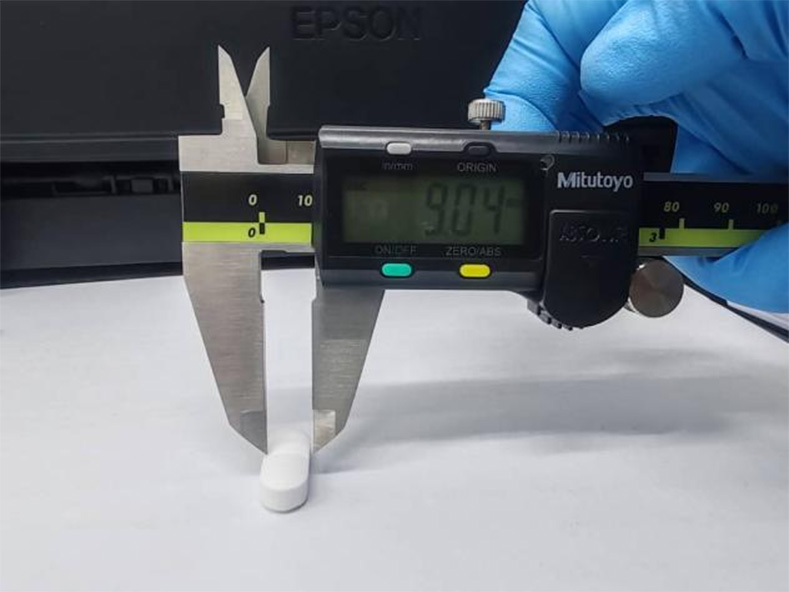
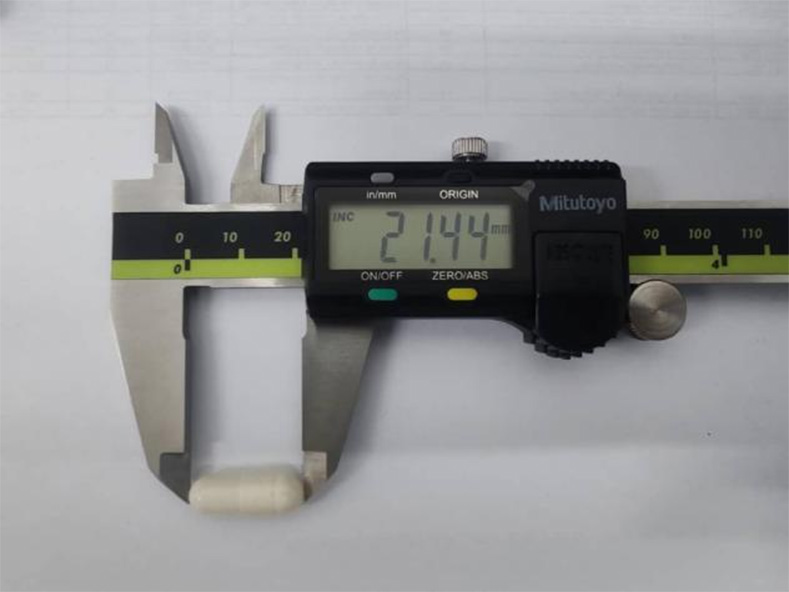
Before anything was designed, both products went under a caliper. The answer to the whole project was in those two numbers.
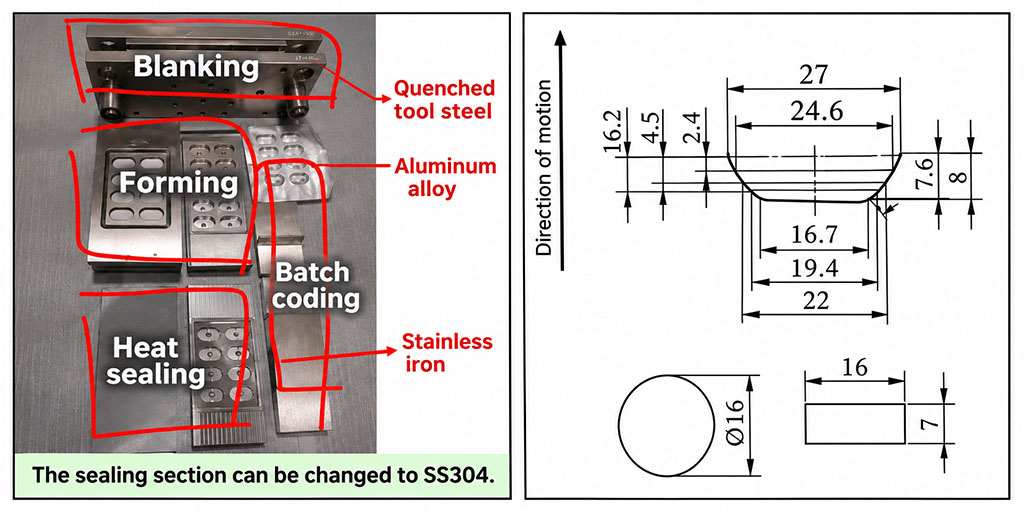
One forming mold, serving both products. The rest of the tooling is what actually does the work.
Where we would not save them money
Having just told them they could share a mold, we told them they could not share a feeder.
A feeder is the part that gets product into the pockets, and it is shaped around the thing it is feeding. A capsule is a smooth cylinder that rolls. An oblong tablet is flat-sided and does not. Set a feeder to handle both and it handles neither one properly: you get pockets that go through empty, product that sits proud and gets caught by the sealing station, and a reject rate that climbs the moment you run at speed.
In alu-alu that matters more than in PVC, because you cannot see into the pack afterwards. The foil is opaque. A pocket that sealed empty looks exactly like a pocket that sealed correctly.
So we specified two feeders, one for each product, and we said plainly that this was not the place to economize. It added cost at exactly the moment we had just removed some. We would rather have that conversation before the order than explain a reject rate afterwards.
The whole project, in one sentence
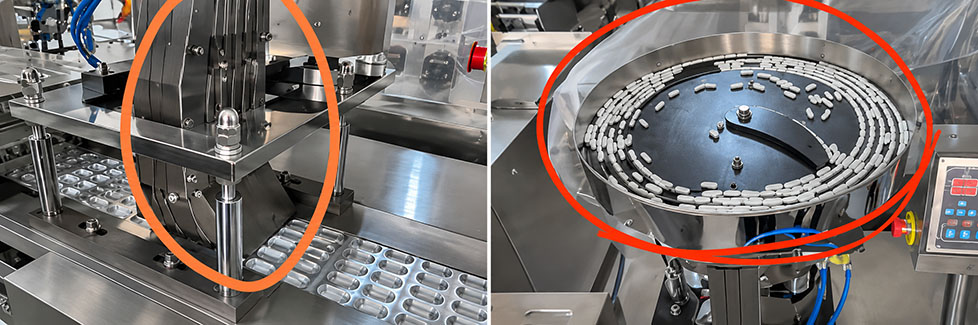
The part we would not economize on: a feeder matched to one product, not a compromise between two.
The camera they had not asked for
Nothing in the inquiry mentioned inspection. We raised it anyway, because of what we had just said about opaque foil.
A camera system sits over the web after filling and looks into every pocket before it is sealed. It is watching for the things an operator cannot reliably catch at production speed — a pocket with nothing in it, a pocket with two, a tablet lying the wrong way up, a product that is chipped or broken. When it finds one, it marks that pack and a reject station takes it off the line automatically.
We did not pitch it as an upgrade. We explained what it looks for and what it does when it finds something, and let them decide whether that was worth having on a pack they would never be able to inspect by eye.
They decided it was, and added the full camera and reject package to the order.
This is the part of the project we would point at if asked what we actually did for them. We reduced the cost of the tooling and we increased the cost of the line, in the same conversation, and both recommendations pointed the same direction: toward a pack that is right when it leaves the machine.
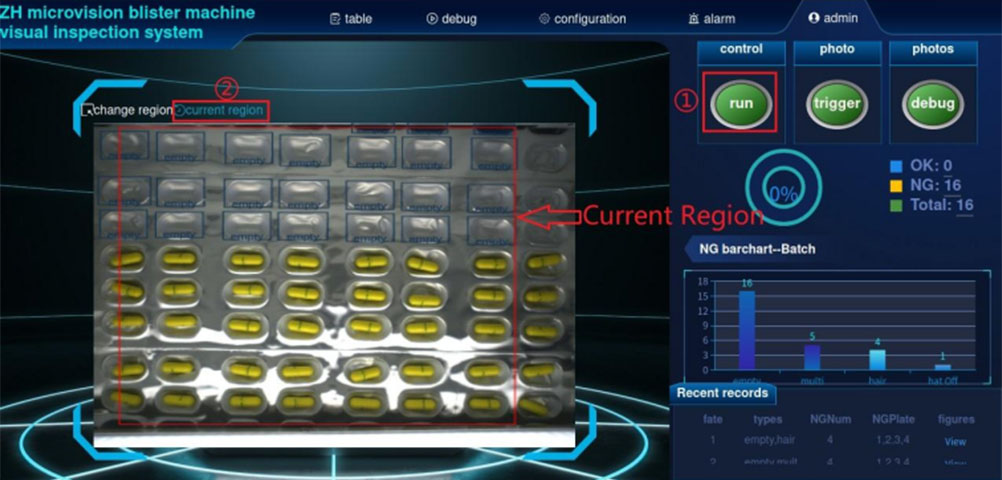
The screen the operator watches: every pocket checked, every reject counted and sorted by reason.
They wanted to watch it run
At some point in the comparison they asked for something straightforward: put a machine on a video call and show us.
Not a brochure, not a reference list. A live camera, a running machine, and someone on the other end who could answer a technical question without going away to check.
We set it up. They watched the machine form, fill, seal and cut, and asked what they wanted to ask while it was happening.
We think more customers should ask for this, including customers who are not talking to us. If a supplier cannot put you in front of a running machine on short notice, that is information. And if they can, you learn more in forty minutes than a quotation will ever tell you.
On their floor in Malaysia
When the machine arrived, our engineer flew out and worked on their floor until it was in production.
That meant going through the whole sequence with their people standing there: changing the mold over, adjusting each feeder to its own product, setting the camera parameters, and confirming the reject logic actually threw out the packs it was supposed to throw out. Each of those is a small job. Together they are the difference between a machine that is installed and a machine that is running.
While he was there, he also looked at other equipment in their plant that was giving them trouble — machines we had not supplied and had no obligation to touch. He helped them work through it and showed their maintenance people what to check.
That was not in the scope. It was also the reason the relationship changed. By the time he left, they were telling us about the next lines they were planning rather than asking us to justify this one.
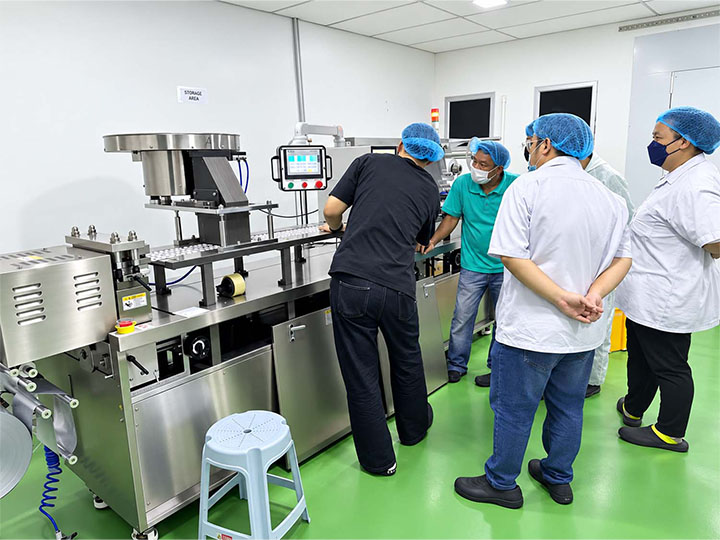
Commissioning in Malaysia: mold changeover, feeder adjustment, camera settings and reject logic, worked through one by one with their team standing there.
If you are holding a stack of quotes that all look the same, the useful question is not which number is lowest. It is which supplier has told you something you did not already know about your own product. Send us the dimensions of what you are packing. We will tell you what can be shared and what cannot — and if the honest answer costs you more, we will tell you that too.
What this line was built from
Blister machine
DPP-260H1, servo driven, configured for alu-alu. Up to 40 punches a minute.
Forming mold
One set, shared between the size 0 capsule and the oblong tablet.
Feeders
Two, one dedicated to each product.
Inspection
Camera system over the web, linked to an automatic reject station.
Commissioning
Our engineer on site in Malaysia for installation, trial production and operator training.
Equipment on this project
Send us the dimensions before you send us a shortlist.
Tell us what products you need on the machine and what film you want to run. We’ll tell you what can be shared between them and what can’t — including the parts where sharing would cost you more than it saves.
01 · Two products, one machine
Send the dimensions of each. That’s usually enough to say whether one mold will do.
02 · Moving to alu-alu
Running PVC now? Alu-alu changes the forming, the feeding and what you can see afterwards.
03 · Want to see it run
Ask us to put a machine on a video call. We’d rather show you than tell you.
Ask us to show you the machine running on a video call. We would rather you saw it than took our word for it.
Rather talk it through?
You can open with: “We want to run two products on one blister machine.”
