
They Already Had a German Gummy Line. Then They Spent Three Months Questioning Ours.
A third-generation nutrition manufacturer in the United States, exporting worldwide, already running a German gummy line. In 2021 they wanted to expand — and they found us through an online ad. What came next was three months of hard questions before anything was agreed. The line they ended up with deposits a thousand kilos an hour and runs on two people a shift.
Nutrition manufacturer
United States (anonymous)
Gummies,
nine mold shapes
Fully automatic,
1,000 kg an hour
Two per shift,
everything included
Some case studies start with a problem. This one starts with a customer who had every reason not to talk to us.
His family had run a nutrition plant for three generations, shipping product worldwide. He had been making gummies for years. The machine on his floor was German. Then an online ad put an unfamiliar Chinese supplier in front of him, at exactly the moment he was planning to expand.
He did not ask for a quotation. He asked what we could prove.
Three months of questions
He knew gummies. Years of making them, with a German line already running on his floor. So when he found us through an online ad in 2021, he did not start by asking for a price. He started by asking whether we were worth talking to.
What followed was three months of questions, answered by one of our senior engineers. Not a sales exchange — a technical one, about how we would handle the things he already knew were hard at volume.
The scheme changed during those three months. It had to. That is what the questions were for.
One of the changes shows up every day on his floor. The mold changeover on the original design used a snap spring. Through the back-and-forth it became a link type instead. His operators now say changing a mold is quick and easy compared with what they were used to — a detail that would never have come up in a conversation that went straight from inquiry to quotation.
If you are weighing a supplier you have not met, this is the part worth copying. Three months of hard questions cost nothing compared with a line that turns out to be wrong, and the answers tell you more about a supplier than any brochure does.
What a one-ton line actually contains
Most people picture a gummy line as a depositor. At this scale the depositor is the small part. Everything in front of it exists to keep it fed without ever stopping.
| Sugar elevator | Automatic, so raw sugar reaches the cookers without anyone carrying it. |
| Automatic weighing | Feeds three 300 L dissolving cookers. The weighing is what takes the manpower out of batching, and what keeps every batch the same. |
| 2-ton syrup storage | Glucose syrup has to be boiled before gummies can be made. The tank holds it and keeps it at temperature, so boiling does not become the bottleneck. |
| Gelatin dissolving | Two 300 L vacuum dissolving tanks, a 600 L storage tank, a 1-ton cooling tank and a 1-ton storage tank. Gelatin at this volume has to dissolve, cool and wait somewhere before it is needed. |
| CFA and actives dosing | Color, flavor and acid, plus the active ingredients, added and mixed as a separate system. This is what lets one line run different recipes. |
| 1,000 kg an hour | The depositor, with a cooling tunnel sized to match it. This is the headline number, but it only reaches it if everything above keeps up. |
Read that list again and notice how much of it is storage and buffering. At one ton an hour, a line is not fast because the depositor is fast. It is fast because nothing upstream ever makes the depositor wait.
For scale: the smallest gummy line we build deposits 80 kg an hour, and for a brand proving a new category that is often the right place to start — we wrote about one that did. This line deposits 1,000. Almost all of the difference between them sits in front of the depositor, not in it.
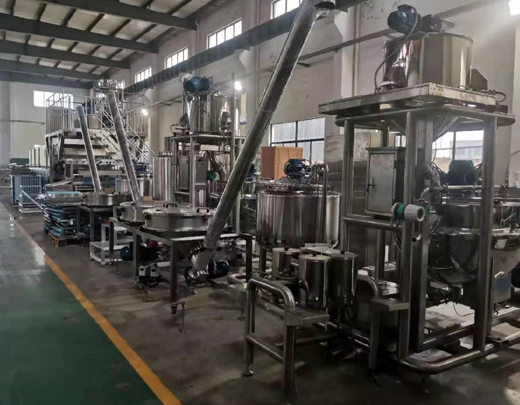
The line as installed. Most of what you see is upstream of the depositor.
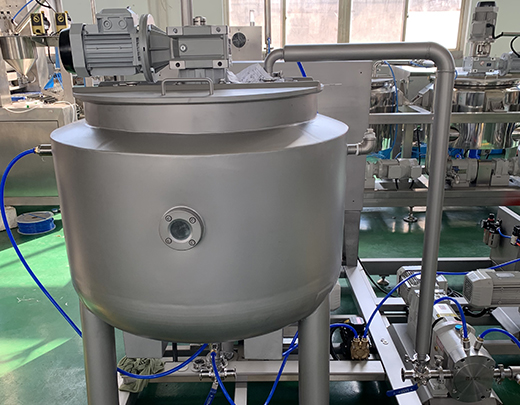
Cookers, tanks and the dosing system ahead of the depositor.
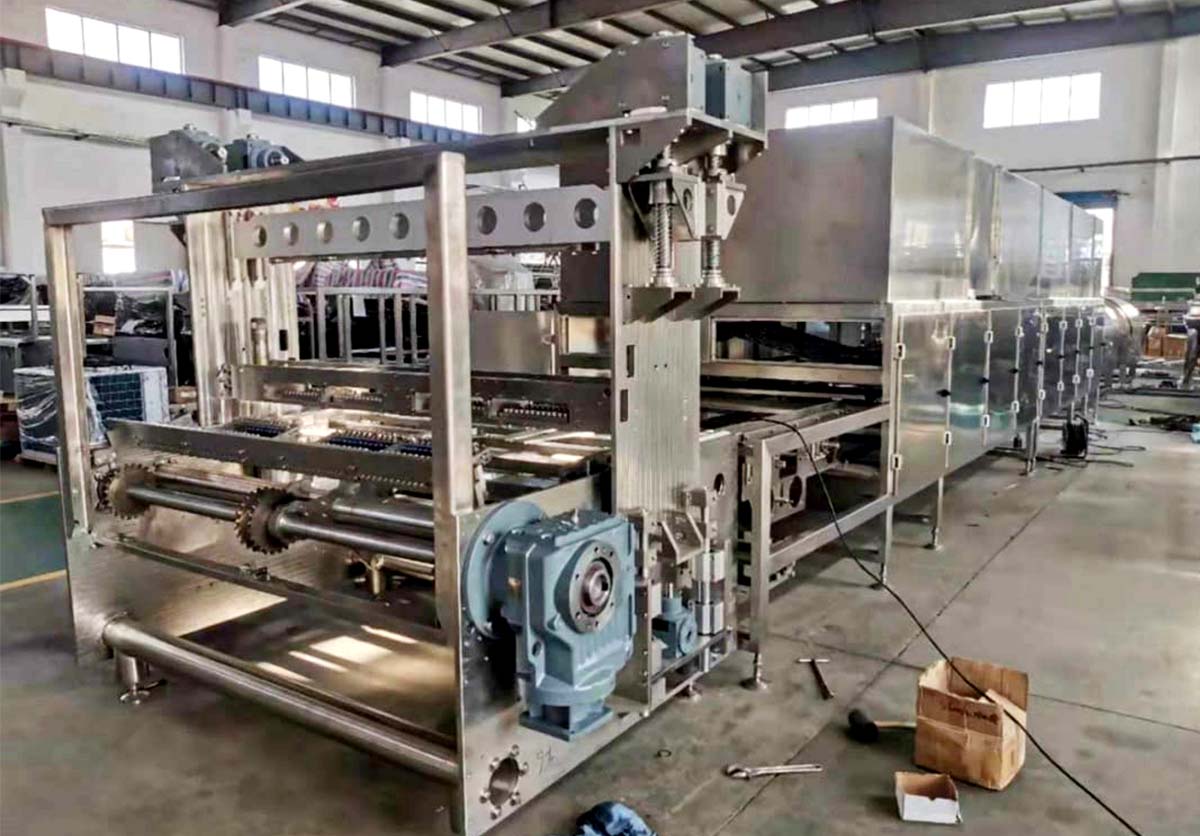
Dissolving, cooling and storage. At this volume, gelatin needs somewhere to wait.
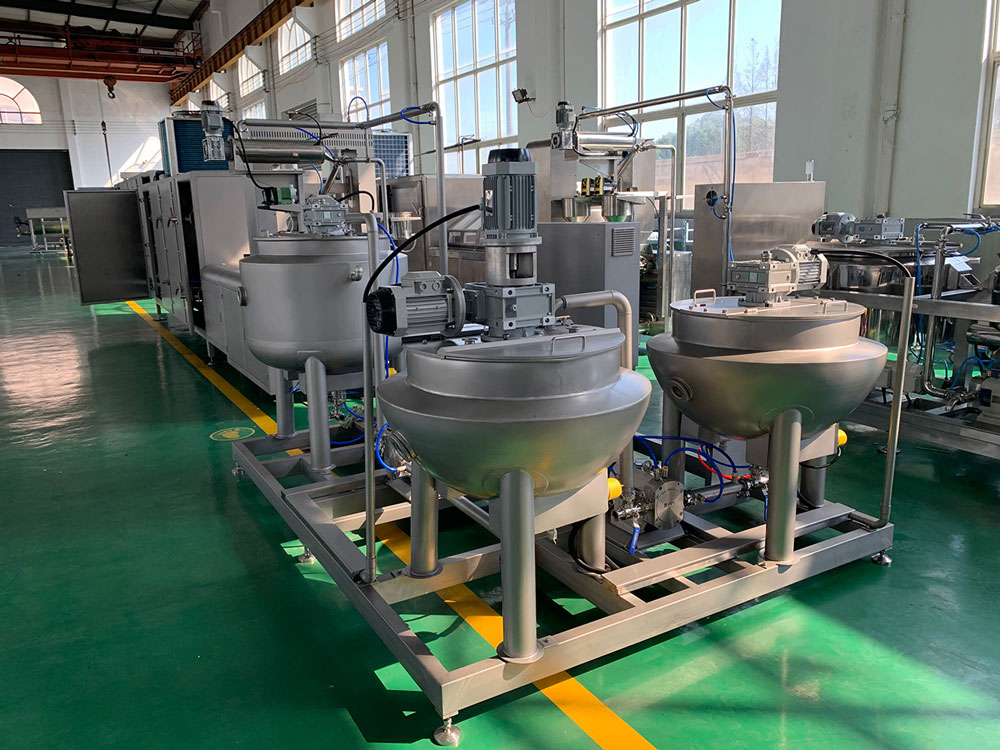
The depositor is the small part. Everything in front of it exists to keep it fed.
Two operators
The line runs on two people a shift.
Not two at the depositor with a crew behind them — two for the whole shift, with changeovers, cleaning and moving material included in the number.
That is the figure worth setting next to the equipment list. A one-ton line with manual batching, manual gelatin handling and manual transfers between stages needs a person at each of those jobs. The sugar elevator, the automatic weighing and the transfers between tanks are not there for elegance. They are there so the shift roster stays at two for the next ten years.
In the U.S., where this line runs, that calculation is sharper than almost anywhere else. Labor is the largest running cost of a confectionery line, and it is the one that goes up every year.
Nine molds
His customers’ tastes vary, so the line was given nine mold shapes.
On a gummy line the mold is the cheapest way to make a different product. Same kitchen, same recipe, same depositor — a different shape is a different SKU, and a different SKU is a different customer. Nine molds is not nine machines. It is nine answers to “can you make this?”
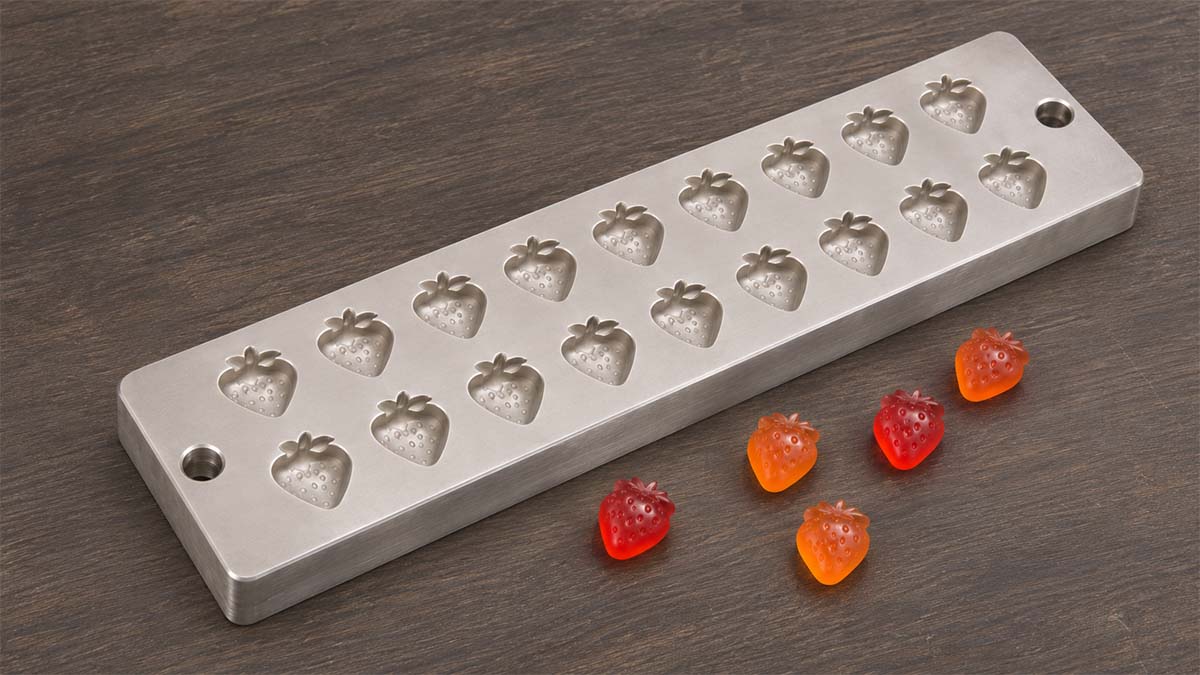
Strawberry
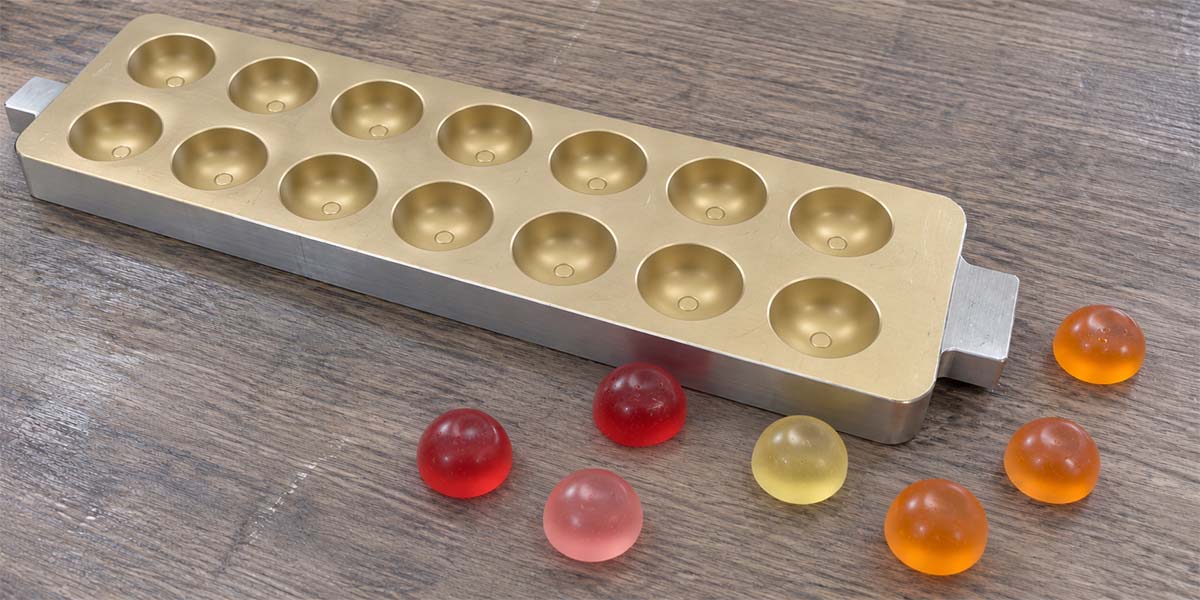
Ring
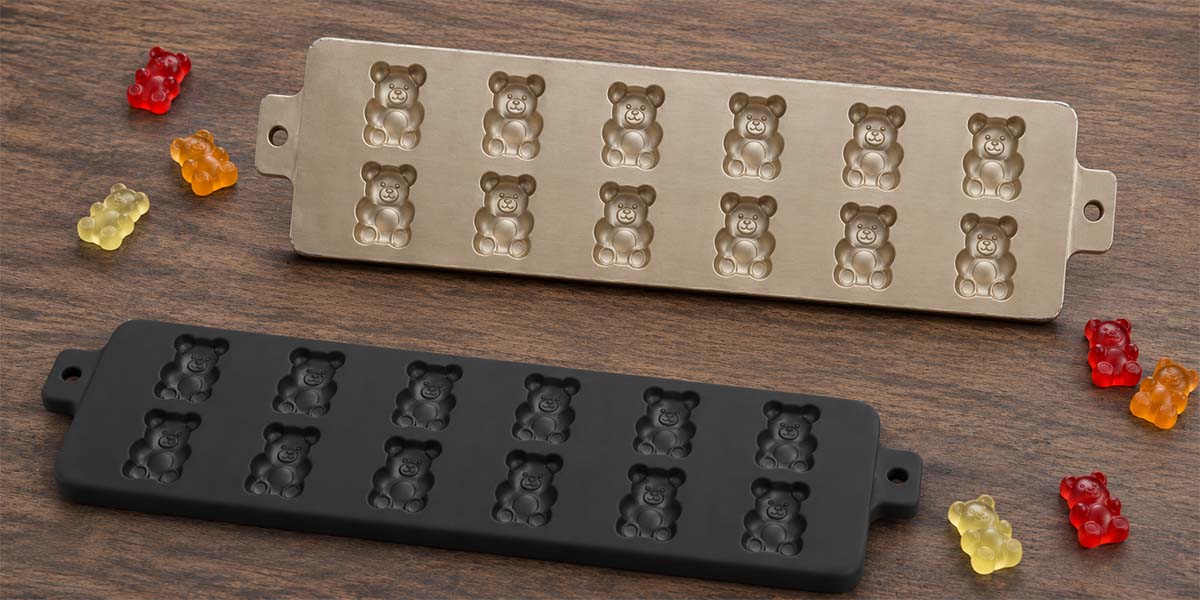
Bear
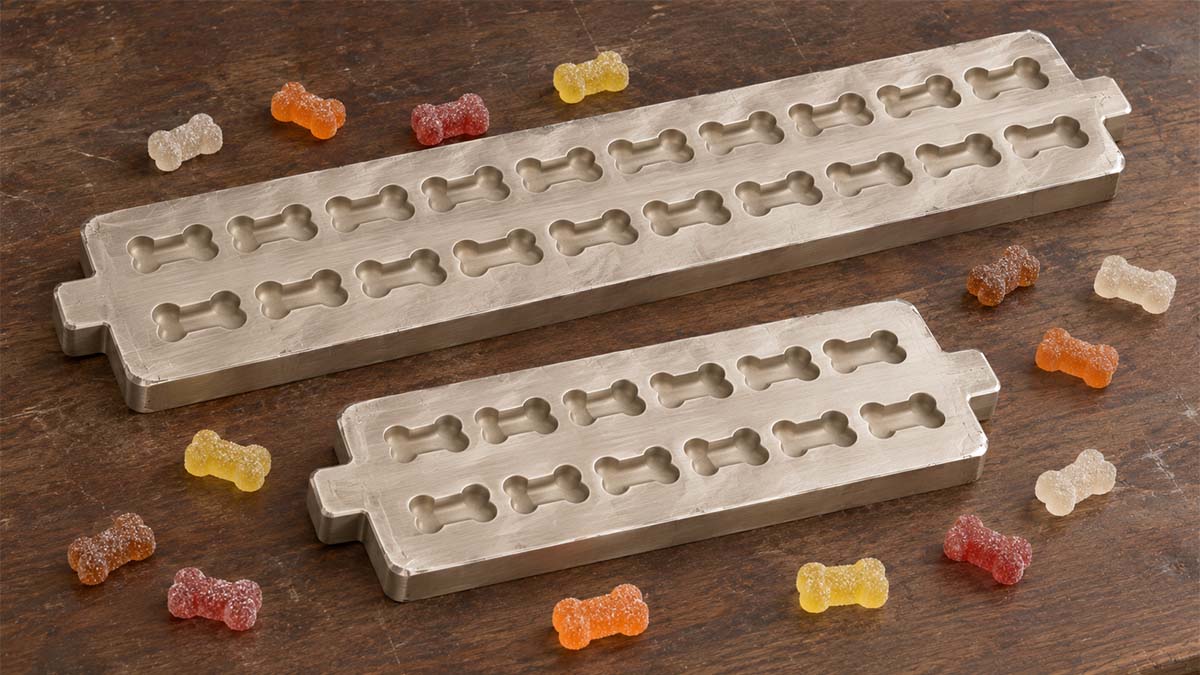
Bone
Four of the nine shapes. The bone shape is a pet supplement mold.
The bone shape is worth noticing on its own. Pet supplements are one of the fastest-moving corners of this market, and they run on the same line as everything else — a different mold, not a different plant.
The part worth borrowing from this project is not the equipment list. It is the three months at the start. He had a German line, years of experience and every reason to be skeptical — so he asked until he was satisfied, and the design got better because of it. If you are looking at a supplier you have not met, that is the cheapest insurance there is.
Equipment on this line
Ask us the hard questions first.
Tell us what you want to make and how much of it. Then ask us whatever you need answered before you would take us seriously — about the design, the materials, the engineering, or the projects we’ve done. That is what the first conversation is for.
01 · Expanding
Running a line already? Tell us the output you need next and what your current line can’t do.
02 · Comparing suppliers
Send us the questions you’re asking everyone. We’d rather answer them now than later.
03 · Starting out
New to gummies? We’ll start from the shapes you want to sell and work backwards.
Ask us the hard questions. That is what the first conversation is for.
Rather talk it through?
You can open with: “We run a gummy line already and we’re planning to expand.”
