
A Capsule Co-Packer Added Softgels. The Floor Plan Chose the Machine.
A U.S. contract manufacturer filled hard capsules and filled them well. The brands they packed for wanted softgels — a format their plant could not make. Four machine configurations were on the table. What decided it was not the price list, but the rooms they already had — and the line they ended up with now runs about 240,000 softgels a day.
Hard capsule co-packer
United States (anonymous)
Dietary supplement
softgels
SEM-100 encapsulation line,
200 L tanks, tumble dryer
About 240,000
softgels a day
In 2018, a contract manufacturer in the United States had what looked like a machine problem and was really a room problem.
Their plant filled hard capsules. The brands they packed for had started asking for something the plant could not make: softgels — the format fish oil, vitamin D and CoQ10 tend to end up in. Turning that work away was getting expensive.
The complication is that a softgel is not another kind of capsule. A hard capsule arrives as two finished shells and gets filled. A softgel is made and filled in the same instant: two gelatin ribbons are formed, the fill is injected between them, and the shell is sealed and cut out of the ribbon in a single pass. Before that can happen, the gelatin has to be melted and held, and the fill has to be prepared separately. Afterward, the softgels have to tumble and dry for far longer than they took to make.
So adding softgels did not mean clearing a bay for a machine. It meant finding room for a sequence of rooms.
Four options, and the floor plan picked one
They sent their factory layout before they asked for a price. That order of events matters, and it is the reason this project went smoothly.
We came back with four configurations at different scales. They chose the middle one: a standard SEM-100 encapsulation machine with the line built around it. Not the cheapest, and not the largest they could have afforded. Two things decided it.
The purpose was trial production. They wanted to prove softgels as a format, win the first orders, and scale after that — not commit their biggest capital line to a product they had never sold.
The rooms they already had. The layout showed exactly what could be given over to softgels without disturbing the capsule lines that were already paying the bills. A larger encapsulation machine would have fit in the manufacturing room on its own. The tanks, the drying and the movement between them would not.
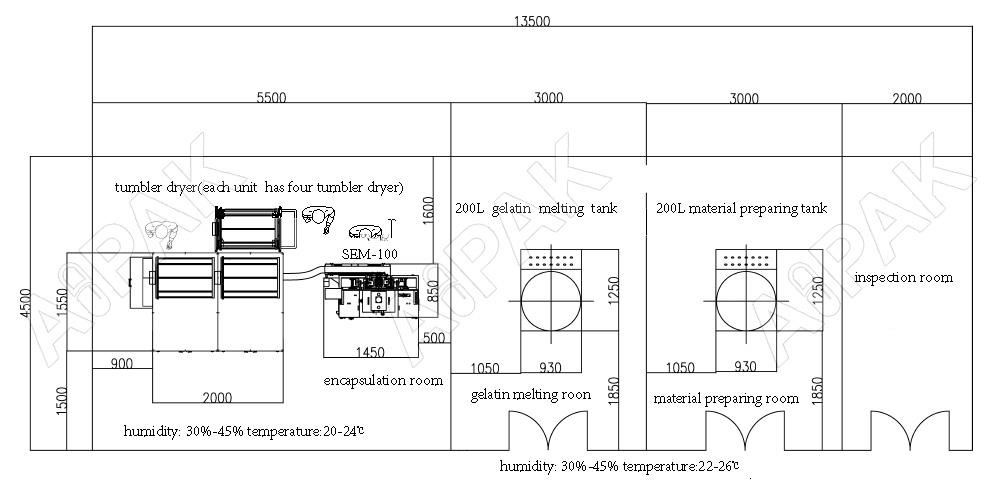
The layout came first. The machine size followed from it.
Softgels are a sequence of rooms, not one machine
This is the part that surprises capsule plants. A hard capsule line is a machine you put somewhere. A softgel line is a route through the building.
Material preparing
The fill is prepared and held here. This plant was given a 200 L preparing tank, placed just behind the existing inspection room.
Gelatin melting
The shell is a separate job from the fill. A 200 L melting tank holds the gelatin at temperature until the encapsulation machine calls for it.
Manufacturing
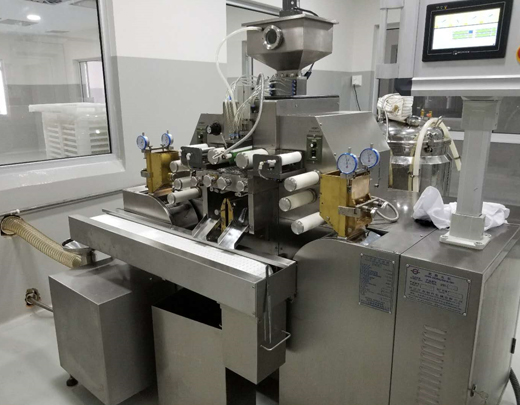
The SEM-100 and the tumble dryer sit together here. The ribbon is formed, filled, sealed and cut in one pass, then the softgels go straight into the dryer.
Two things follow from that, and both are easy to miss when you are costing a softgel project from a machine price alone.
The fill and the shell are prepared in parallel, in different places. Gelatin has to be melted and held ready; the fill has to be made and held ready. They meet for the first time inside the encapsulation machine. That is two tanks, two rooms, and material moving between them on a schedule.
Drying takes far longer than encapsulating. Softgels come off the machine soft. They tumble, then they sit and dry. The drying area has to be sized for the time, not for the hourly rate — which is why a bigger encapsulation machine does not automatically mean a bigger output if the drying space stays the same.
The 200 L preparing tank, in its own room behind the inspection room.
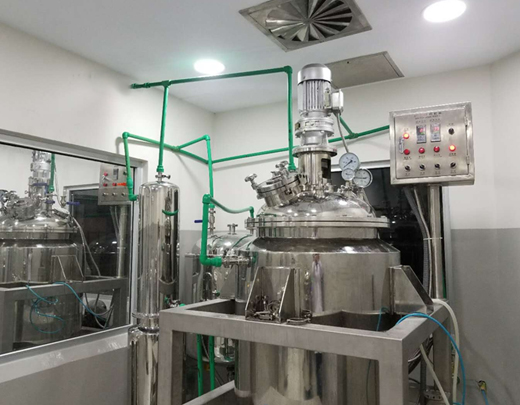
The 200 L gelatin melting tank, in the room next door.
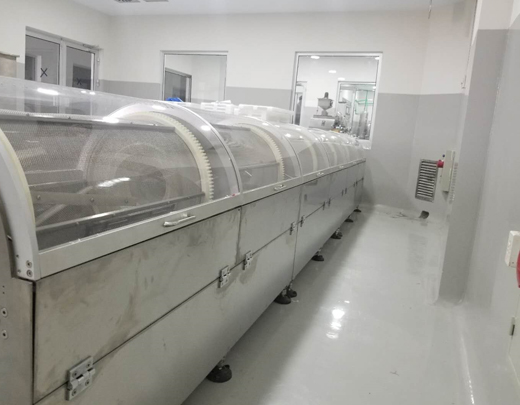
The tumble dryer shares the manufacturing room with the encapsulation machine.
The die roll set is what defines your product
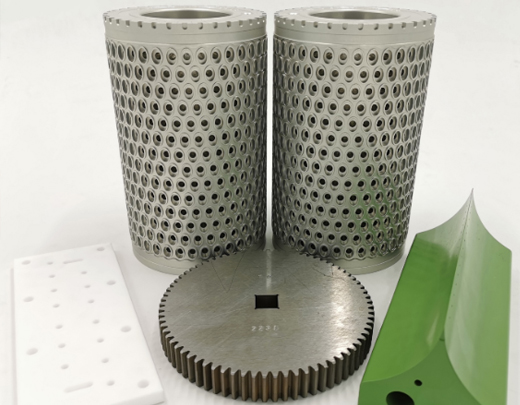
Inside the encapsulation machine, one part decides what your softgel actually looks like: the die roll set. Two rolls turn against each other, each carrying the negative of half a softgel. The gelatin ribbons pass between them, the fill is injected at the moment the two halves meet, and the same rolls seal and cut the finished softgel out of the ribbon.
Which means the die roll set, not the machine, determines the shape and the size. Oval, oblong, round, oblong with a flat face — each is a different set, machined for that shape and that fill volume.
Die roll set 1
Die roll set 2
Die roll set 3
Die roll set 4
Die roll sets. The shape and size of your softgel is machined into these.
So the question to settle early is not how fast the machine runs. It is which shapes and sizes you intend to sell, and how often you expect to add another one.
If you are comparing softgels against liquid-filled hard capsules for the same product, the die roll set is one of the practical differences: a new softgel shape means a new set of rolls, while a hard capsule changes size by changing the change parts and the capsules themselves.
What it produced
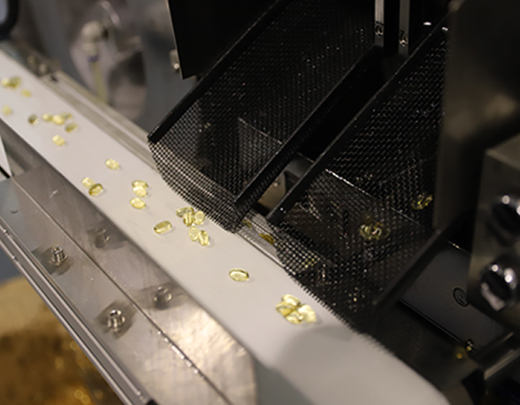
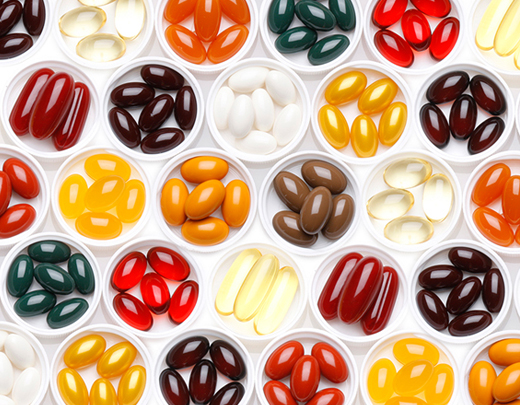
Softgels off the line. The trial production this whole project was built to make possible.
The line settled at around 240,000 softgels a day.
For a supplement brand that number is easier to hold onto in bottles: at 60 softgels a bottle, 240,000 a day fills about 4,000 bottles. And this is still the line that was specified as trial production, in the rooms they could spare.
From the order to the line running in their plant took at least six months. That covers building the equipment, ocean freight, the customer's own room preparation and utilities, and commissioning on site. A softgel line is a building project as much as an equipment purchase, and that is worth allowing for at the planning stage rather than discovering it.
But the number that says the most about this project is not the daily output. It is what they bought next.
They came back for more die roll sets. Every new set is another shape or another fill size — which is another product they can quote for. The range grew, and the machine they bought in 2018 grew with it, because the part that defines the product is the part you can add.
They came back for a softgel inspection machine. This is what volume does to quality control. At a few thousand softgels a shift, people can look at them. At 240,000 a day they cannot, and inspection has to become a machine of its own.
Neither purchase was in the original plan. Both were the consequence of the first one working.
If you run a capsule plant and softgels are on the table, the useful thing to borrow here is the order they did it in. They sent the floor plan first and asked for a price second. The rooms they had decided which of four machines made sense — and that is a far cheaper way to find out than discovering it after the equipment ships.
Equipment on this line
Send the floor plan first. The price makes more sense after.
Tell us what you want to encapsulate and send whatever you have of your layout — a CAD file, a PDF, or a sketch with dimensions. We’ll come back with the line drawn into your rooms, and the machine size that actually fits them.
01 · Thinking about it
Tell us what the brands you pack for are asking for, and we’ll scope a trial line.
02 · Have the rooms
Send the layout. We’ll show you what fits and what it leaves out.
03 · Already encapsulating
Looking to add shapes or raise output? We’ll check it against your line.
Every quote comes with a layout drawing of the line in your rooms.
Rather talk it through?
You can open with: “We fill hard capsules and we’re looking at adding softgels.”
